
(1) to continue to build and strengthen local capacities around ELC installation and development; and (2) to further improve the open-source ELC design
By loading the map you accept the privacy policy of Google.
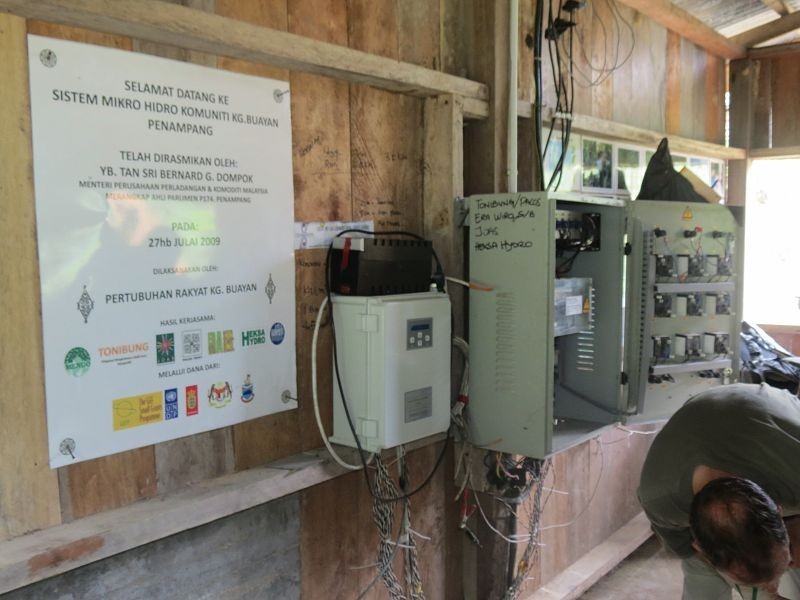 The Hydro Empowerment Network (HPNET), a community of micro-hydro practitioners in South and Southeast Asia, has identified electronic load controllers (ELC) as one of the crucial and complex components of micro-hydro systems. ELCs are important in micro-hydro systems because they maintain the electrical specification within safe parameters through monitoring variable consumer demand and balancing it with the power generated by a turbine. While micro-hydro civil works, turbines, generators and transmission lines can be installed using locally available technical skillsets, ELCs require more specific and in-depth training to be correctly installed and maintained.
Recognising this gap in the skills of local technicians and the need to strengthen their knowledge, HPNET partners Asosiasi Hidro Bandung (AHB) and Simple Engineering hosted a practical training session on ELCs in 2016. From this exchange, SIBAT (an organisation from the Philippines) and TONIBUNG (a Malaysian partner) identified the need for an open-source ELC design that was lower cost, and could be assembled, maintained and repaired locally for smaller capacity micro-hydro systems. Collaboration with Green Empowerment and EWB-UK resulted in the creation of such a design and the first model was installed in a community in the Philippines in 2017.
Based on these successful exchange activities and collaborations, this new knowledge exchange supported by WISIONS has two specific objectives: (1) to continue to build and strengthen local capacities around ELC installation and development; and (2) to further improve the open-source ELC design. The proposed activities are as follows:
The Hydro Empowerment Network (HPNET), a community of micro-hydro practitioners in South and Southeast Asia, has identified electronic load controllers (ELC) as one of the crucial and complex components of micro-hydro systems. ELCs are important in micro-hydro systems because they maintain the electrical specification within safe parameters through monitoring variable consumer demand and balancing it with the power generated by a turbine. While micro-hydro civil works, turbines, generators and transmission lines can be installed using locally available technical skillsets, ELCs require more specific and in-depth training to be correctly installed and maintained.
Recognising this gap in the skills of local technicians and the need to strengthen their knowledge, HPNET partners Asosiasi Hidro Bandung (AHB) and Simple Engineering hosted a practical training session on ELCs in 2016. From this exchange, SIBAT (an organisation from the Philippines) and TONIBUNG (a Malaysian partner) identified the need for an open-source ELC design that was lower cost, and could be assembled, maintained and repaired locally for smaller capacity micro-hydro systems. Collaboration with Green Empowerment and EWB-UK resulted in the creation of such a design and the first model was installed in a community in the Philippines in 2017.
Based on these successful exchange activities and collaborations, this new knowledge exchange supported by WISIONS has two specific objectives: (1) to continue to build and strengthen local capacities around ELC installation and development; and (2) to further improve the open-source ELC design. The proposed activities are as follows:
- Four practitioners each from Malaysian Borneo and the Philippines with experience in community micro-hydro systems will learn to assemble, maintain and repair open-source ELCs by attending a four-week training course. The training modules include theory, manufacture, installation, maintenance and testing using a test rig, followed by a site visit.
- Regional experts from Sri Lanka and Indonesia will be invited to support the secondary objective of the exchange, i.e. to continue to develop, innovate and improve the ELC design into production-ready technology for the benefit of the whole HPNET working group.
Projects with same technology
Low Head Micro Hydropower Systems for Application in Poor Villages in the Amazon Region
Improve the living conditions of the village population through access to modern energy
Community-based Micro Hydropower for Electrification and Livelihood of Remote Indigenous Villages in Mindanao
Projects in same country
Exchange: Waste to Wisdom: Supporting Biodigester Practitioners in South East Asia
This knowledge exchange activity aims to address the technical gaps in organisations in Malaysia and the Philippines by providing them with the skills to install and operate biogas digester systems efficiently and affordably.
Exchange: A Participatory Gaming Approach To Community Energy Planning in Southeast Asia: Spreading Best-Practices on Community Engagement
To increase community understanding of mini-grid design, management and operation